Table of Contents
As global demand for faster and more stable internet connections continues to grow, the importance of fiber optic drop cable technology has become increasingly clear. These cables play a critical role in FTTH (Fiber to the Home), FTTB (Fiber to the Building), and other broadband communication systems by connecting the main distribution network directly to end users. Given the wide variability in installation environments and network requirements, manufacturers have developed a diverse range of fiber drop cables to meet the needs of various indoor, outdoor, residential, and commercial applications. Understanding the main types available today can help telecom providers, contractors, and businesses select the most suitable solution for long-term network performance and reliability.
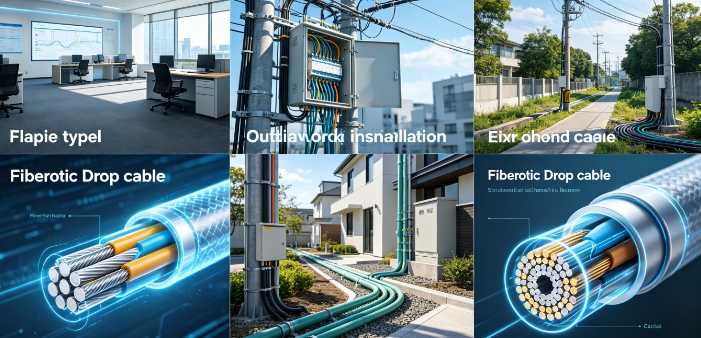
Indoor Fiber Optic Drop Cable
Indoor installations require flexible and lightweight cable structures that are easy to route through walls, ceilings, and narrow spaces. This type of fiber optic drop cable is commonly used in apartments, offices, and residential buildings.
- Compact cable structure: Indoor models are designed with smaller diameters, making installation simpler in limited spaces.
- Flame-retardant jacket materials: Many indoor cables use LSZH (Low Smoke Zero Halogen) materials to improve fire safety in enclosed environments.
- Excellent bending performance: Flexible designs help maintain stable signal transmission even when cables are bent around corners.
- Lightweight installation advantages: Technicians can install indoor cables quickly without requiring heavy support structures.
These characteristics make indoor cables an ideal choice for short-distance deployment within residential and commercial buildings.
Outdoor Fiber Optic Drop Cable
Outdoor environments expose cables to sunlight, moisture, temperature changes, and physical stress. As a result, outdoor fiber optic drop cable products are designed with stronger protective layers and weather-resistant materials.
- UV-resistant outer jackets: These help protect the cable from long-term sun exposure and environmental aging.
- Waterproof protection layers: Gel filling or water-blocking yarn prevents moisture from damaging optical fibers.
- Enhanced tensile strength: Outdoor models often include steel wires or FRP reinforcements to withstand pulling forces during aerial or duct installations.
- Long-distance deployment capability: Durable structures support stable data transmission across larger outdoor network areas.
Because of their durability, outdoor cables are widely used in telecom infrastructure and rural broadband projects.
Self-Supporting Fiber Optic Drop Cable
Self-supporting cable designs are especially popular in aerial network installations where additional messenger wires are unnecessary. This type of fiber optic drop cable combines communication performance with structural support.
- Integrated support member: Built-in steel wire or dielectric support allows direct aerial installation between poles.
- Reduced installation complexity: Fewer external accessories are required, lowering labor and installation costs.
- Improved wind resistance: Reinforced structures help maintain cable stability in outdoor weather conditions.
- Suitable for rapid deployment: Telecom operators often use self-supporting cables for fast FTTH network expansion.
These advantages make self-supporting cables highly efficient for urban and suburban aerial deployments.
Flat and Round Fiber Optic Drop Cable Designs
Another important classification of fiber optic drop cable is based on cable shape, as different structures provide different installation benefits.
Flat Drop Cable
- Easier to attach to walls and building surfaces.
- Better resistance to twisting during installation.
- Commonly used in FTTH indoor and outdoor transition areas.
Round Drop Cable
- Offers stronger mechanical protection for optical fibers.
- Performs well in conduit and underground installations.
- More suitable for environments with high durability requirements.
Both designs are widely used, and the choice often depends on installation methods and environmental conditions.
Specialized Fiber Optic Drop Cable Solutions
As communication networks become more advanced, specialized fiber optic drop cable solutions are increasingly being developed for unique applications.
- Armored cables: Include metal protection layers to resist rodent damage and harsh physical environments.
- Mini drop cables: Ultra-compact designs suitable for high-density urban deployments.
- Pre-connectorized cables: Factory-installed connectors reduce on-site installation time and improve efficiency.
- Bend-insensitive fiber cables: Designed to maintain signal quality even in extremely tight routing conditions.
These specialized options help network providers address complex installation challenges while maintaining high-speed transmission performance.
Conclusion
In conclusion, the modern fiber optic drop cable market offers a wide range of solutions designed for different installation environments and network requirements. Indoor cables prioritize flexibility and safety, while outdoor and self-supporting designs focus on durability and environmental resistance. Flat, round, armored, and bend-insensitive cables further expand installation possibilities for telecom providers and businesses. Choosing the right cable type is essential for ensuring long-term network stability, efficient installation, and reliable high-speed communication. As global broadband infrastructure continues to evolve, fiber drop cable technology will remain a key component, facilitating faster and more reliable network connectivity.
0