Table of Contents
Slopes that become unstable due to factors such as joints, weathering, and infiltration of rainwater are some of the problems that can be seen in geotechnical applications like highways, railways, and mines. The hollow grouting bar, commonly referred to as a self-drilling anchor bar in geotechnical engineering, offers an advanced solution. Unlike conventional steel tendons that function passively, the technique penetrates deep slip surfaces to provide tensile strength to the structure while injecting grout to strengthen the fractured rock masses at the same time. The use of surface locking assembly and the absence of casing in self-drilling make the fundamental reasons that cause slope failure less possible. The following is a description of the four engineering principles on how the Hollow Injection Bar provides long-term slope stability.
1. Hollow Injection Bar Transfers Loads Across Slip Surface Through Deep Anchoring
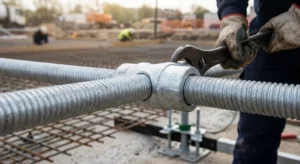
The primary cause of slope failure is when the shear stress across the failure plane exceeds the shear strength of the rock or soil mass. As a strong and continuous threaded tendon, the Hollow Injection Bar acts as a tie between the unstable surface layer and deep bedrock.
High-Tensile and Shear Resistance Performances
- Deep Anchoring Method: This is achieved by piercing through the active slip zone, whereby the Hollow Injection Bar is firmly connected to the underlying stable rock formations directly.
- Strength Factors: Made of high-quality seamless alloy steel pipe, heavy hollow bars (for instance, ONTON R32 and R38 series) have a yield strength between 450 and 650 MPa, while their ultimate tensile load capacity ranges from 750 to above 900 kN.
Shear Deformations Restriction and Micro-Displacement Prevention
With gravity or water saturation acting on the upper mass, the installed Hollow Injection Bar will respond instantly due to passive stress loading. This will lead to the transformation of horizontal shear forces into tensile stress loads on the steel bar. This is done to prevent shear deformations and micro-displacements from triggering sudden slope failure.
2. High-Pressure Grouting Consolidates Fractured Ground Through the Hollow Injection Bar
Aside from its mechanical tensile capacity, the void in the Hollow Injection Bar transforms the bar into a high-pressure injection channel, which alters the weak ground chemically and physically from within.
Slurry Injection and Fracture Plug Formation
Under injection pressure between 2.0 and 5.0 MPa, cement grout flows out of the flushing ports of the drill bit at the bottom end. The grout is injected into the annulus space between the bar and the drill hole, and simultaneously into the micro-fissures, fault gouge, and weathered joint within a radius of 0.5 to 1.5 meters.
Improvement in Geotechnical Properties
Once set, the cement grout mass binds the loose rock debris and transforms it into a compact and high-capacity grout mass, thereby improving ground shear strength properties:
| Geotechnical Parameter | Unreinforced (Weathered Rock / Scree) | Post-Grouting (Cemented Mass) | Improvement Factor |
| Cohesion | 10 – 25 kPa | 80 – 200 kPa | 3x to 8x increase |
| Internal Friction Angle | 18° – 28° | 32° – 42° | 30% – 50% increase |
| Unconfined Compressive Strength | < 1.5 MPa | 15 – 30 MPa | Over 10x increase |
For hostile or wet slope conditions, galvanized alternatives such as the ONTON Galvanized Self-Drilling Anchor Hollow Bars with hot-dip galvanization, having a zinc coating with a thickness greater than 85 μm, ensure that the steel tube is protected from acidic water to maintain its structural integrity for a lifetime of 50 to 100 years.
3. Redistribution of Surface Stress Helps in Avoidance of Localized Failure of the Slope
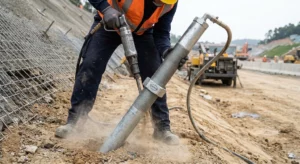
Slope failures tend to begin as localized spalling or small blocks falling, before turning into overall failure. Using special head elements, the Hollow Injection Bar helps in the formation of a three-dimensional surface containment system.
Pre-Tensioning and Surface Clamping
After the installation process, an anchor nut and dome steel plate are attached in order to provide an initial pre-tensioning force of 50 to 150 kN to the slope face. This localized stress helps in compressing the soil surface and avoiding any shallow failures.
Combined Structural Retaining
In case the Hollow Injection Bar heads are combined with a shotcrete facing layer (usually 10 to 20 cm thick) or wire mesh, a connected structural pattern is created:
4. Hollow Injection Bar Eliminates Borehole Collapse Hazards
Traditional drilling methods, which involve hole drilling, extraction of casing pipes, and inserting a bar into a hole, commonly face problems of hole collapse, frequently causing additional sloughing of the slopes during the construction work. With a self-drilling Hollow Injection Bar, all these drawbacks are fully addressed.
Drilling, Grouting, and Anchoring Procedure Only Once
Self-drilling Hollow Injection Bars serve as drill rods, equipped with a sacrificial drill bit at their endpoint:
- Drilling Without Casing Pipes: The rod is drilled down to the necessary depth (generally from 6 to 30 meters), after which it remains in position without the need to extract any tubes.
- Borehole Stability: When it comes to very fragile soils, thin cement grout is injected during the drilling procedure in order to ensure stability of the borehole walls.
Protection of Native Slope Strata Original Self-Supporting Characteristics
Exclusion of a sophisticated procedure of casing pipe installation and extraction leads to a reduction in mechanical vibrations in the native slope strata by more than 60%, maintaining their original self-supporting characteristics.
Conclusion
Hollow Injection Bar is not only an anchor but also a system of slope stabilization which combines deep shear resistance, pressure grouting of soil, stress redistribution, and minimal drilling. It achieves stability by increasing the Factor of Safety (FoS) for both shallow and deep failures. In terms of protecting infrastructure in challenging geotechnical environments on a long-term basis, designing the structure with corrosion-resistant Hollow Injection Bar systems like the hot-dip galvanized product offered by ONTON provides a safe solution built to last a lifetime.
0