Table of Contents
There is no exaggeration at all in claiming that Michael Jordan is among the best players in NBA history. But how much of the glory earned by him is attributed to his statistics? Jordan has six championships; he is the winner of five regular-season MVP titles, and he is also the ten-time scoring champion. But his statistics get extremely impressive when his consistency, efficiency in scoring, playoff performance, and defensive skills are considered.
1. How Did Michael Jordan’s Career Statistics Showcase His Dominance?
However, the most impressive feat from Jordan statistically was not his performance during one fantastic year. His consistent excellence is what set him apart.
1.1 Michael Jordan’s Career Scoring Numbers
Jordan has 32,292 points in his career from 1,072 regular-season games played, scoring an average of 30.1 points per game – the all-time high in NBA history. He has been crowned the scoring champion ten times, including the 1986-1987 season, when he scored 37.1 points on average.
| Statistic | Career Average or Total |
| Games Played | 1,072 |
| Total Points | 32,292 |
| Points Per Game | 30.1 |
| Rebounds Per Game | 6.2 |
| Assists Per Game | 5.3 |
| Steals Per Game | 2.3 |
| Field Goal Percentage | 49.7% |
These numbers reveal much more than just scoring. It was a constant presence for Jordan through rebounding, ball-handling, and defense. Since he retired twice during his career, his scoring average gives a different perspective on how dominant he was.
1.2 Was Michael Jordan an Efficient Scorer?
High scoring does not necessarily indicate effective offense. Offensively, Jordan had an efficiency of 49.7% from the field, 83.5% from the free-throw line, and about 56.9% true shooting percentage. Jordan’s offensive game was based on using midrange jump shots, drives, post-ups, and free throws rather than many three-point shots.
However, when comparing his offensive efficiency to that of the modern players, some considerations should be made. The reason for this is that various things like spacing, defense, and offensive systems have largely helped the modern NBA score.

2. How Do Michael Jordan’s Career Stats Compare in the NBA Playoffs?
The playoffs demand superior defensive preparation, greater pressure, and less margin for error. Jordan excelled in spite of all this.
2.1 Why Did Michael Jordan Score More in the Playoffs?
Across 179 playoff games, Jordan scored 5,987 points and averaged 33.4 points per game, exceeding his regular-season average of 30.1.
| Statistic | Regular Season | Playoffs |
| Games Played | 1,072 | 179 |
| Points Per Game | 30.1 | 33.4 |
| Rebounds Per Game | 6.2 | 6.4 |
| Assists Per Game | 5.3 | 5.7 |
| Field Goal Percentage | 49.7% | 48.7% |
The higher playoff scoring average is a consequence of his being more responsible offensively when facing defenses tailored to take him out.
Nevertheless, the slightly lower field goal percentage proves that higher production levels do not necessarily go hand-in-hand with better efficiency. The great accomplishment here was sustaining such an output while drawing more defensive attention.
2.2 What Does Michael Jordan’s 6–0 Finals Record Really Mean?
Jordan participated in the NBA Finals six times, and he came out victorious each time: 1991, 1992, 1993, 1996, 1997, and 1998. Moreover, in addition to that, Jordan was able to achieve the designation of being named MVP in all the championship seasons mentioned above.
In 1993, during the NBA Finals against the Phoenix Suns, Jordan achieved an average score of 41.0 points per game, which is the record for the most points in a single Finals season in NBA history. But it should be noted that Jordan’s perfect performance in the NBA Finals reflects his play after reaching the Finals.
2.3 Which Michael Jordan Playoff Performances Stand Out?
Two performances illustrate different aspects of Jordan’s playoff greatness.
1986 Against the Boston Celtics
He scored 63 points in a double overtime loss in the playoffs to set a postseason scoring record that continues to stand in NBA history.
His remarkable individual scoring ability was on full display even though his team lost.
1998 NBA Finals, Game 6
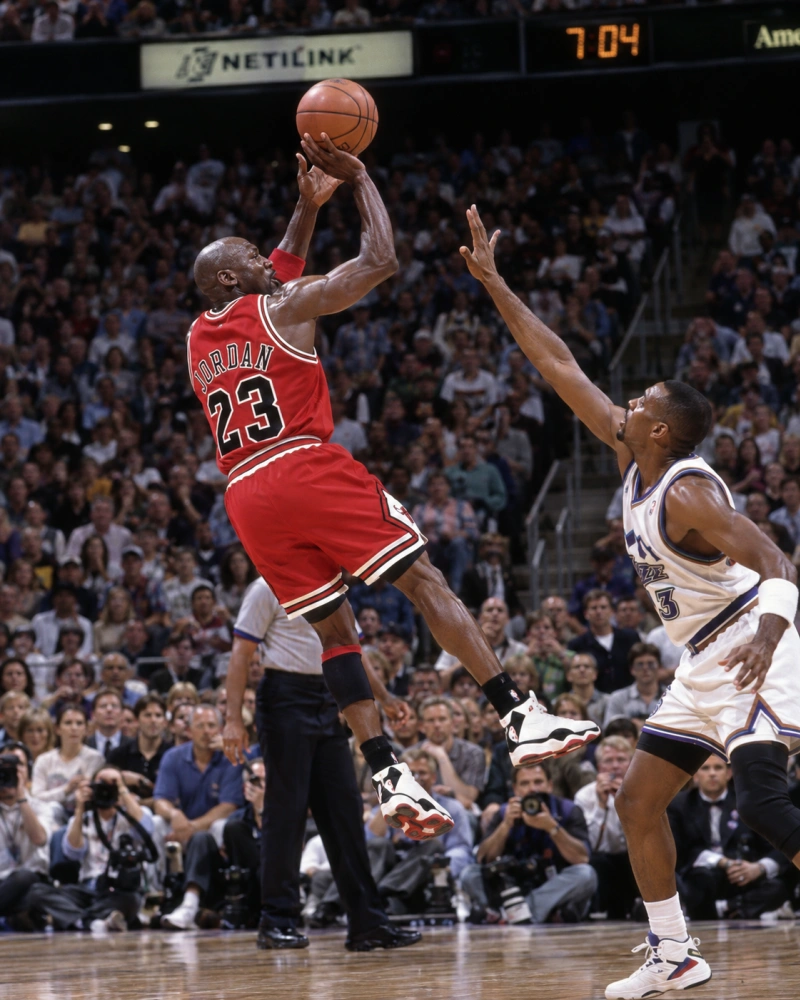
In a game against the Utah Jazz, Jordan netted 45 points and hit a key jump shot near the end to win the game 87-86 and give Chicago their sixth title.
Individual success in scoring was shown in one game, while team success through execution won the other game.
3. What Do Michael Jordan Career Stats Tell Us About His NBA Legacy?
Scoring and championships dominate discussions about Jordan, but his impact extended beyond offense.
3.1 Was Michael Jordan More Than Just a Scorer?
The year Jordan became the NBA Defensive Player of the Year was 1988, and he was chosen for the All-Defensive First Team nine times in his career.
Additionally, Jordan had an average of 2.3 steals per game in his regular seasons, and he won five MVP awards. This shows that Jordan was efficient both offensively and defensively. It was his efficiency defensively while having offensive duties that made Jordan competitive.
3.2 Can Statistics Alone Determine the Greatest NBA Player?
Career statistics of Jordan present quite evident evidence of the high quality of his career, but there is no single element that proves his superiority over others as the best of all time.
The following three elements must be considered:
• Performance of the individual: average score, effectiveness, plays in defense, consistency in playoffs.
• Performance of the team: titles, appearances in finals, role of the player in the team.
• Time period: playing speed, league rules, tactics, duration of career.
For example, the sum of scores gives the advantage to the players with more experience, but average scores are dependent on playing speed. The fact of Jordan’s retirement had an impact on Jordan’s career statistics twice. Only then is it possible to make such a comparison of the past.
Conclusion
The career statistics of Michael Jordan are characterized by great consistency regarding scoring abilities and competitiveness in the playoffs.
The average of 30.1 points per game in the regular season and 33.4 points per game in the playoffs, ten scoring titles, six championships, and six Finals MVP awards constitute an ideal statistical record. Defensive Player of the Year and nine selections to the All-Defensive First Team prove his defensive skills. Finally, one cannot sum up the career of Michael Jordan in one record only.
0