Table of Contents
In today’s digital era, the demand for high-speed, reliable, and scalable internet has reached unprecedented levels. From streaming 4K and 8K videos to supporting cloud computing, remote work, and IoT devices, modern networks require infrastructure that can handle enormous data loads. Traditional fiber optic deployment methods, while effective, often face limitations in installation speed, scalability, and maintenance costs. Enter the air-blown fibre cable, an innovative solution poised to transform high-speed internet infrastructure worldwide.
What Is Air Blown Fibre Cable?
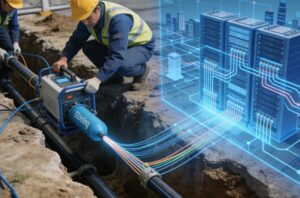
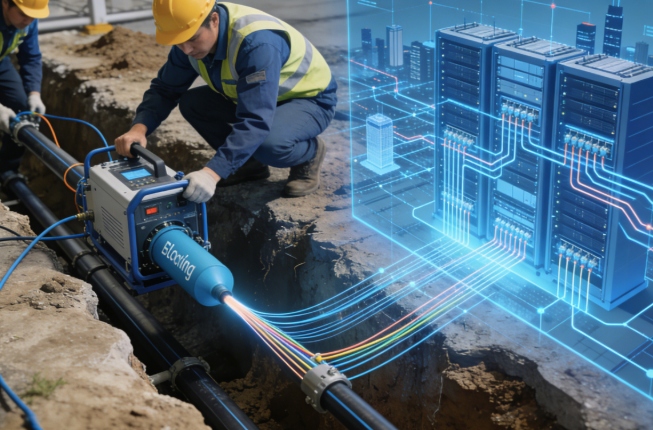
An air-blown fibre cable is a type of optical fiber specifically engineered for installation using compressed air through microduct systems. Unlike traditional fiber cables that must be pulled through conduits—a process that can be time-consuming, labor-intensive, and prone to damage—air-blown cables are lightweight and flexible. Operators can “blow” multiple fiber strands into a single microduct, allowing for rapid deployment and easy future upgrades. This technology not only simplifies installation but also minimizes the need for disruptive construction.
Technical Advantages of Air Blown Fibre Cable
- High Flexibility and Scalability
One of the most significant advantages of air-blown fibre cableis its ability to support network expansion without major overhauls. Service providers can add or replace fibers in existing ducts as demand grows, making it ideal for areas with rapidly changing bandwidth requirements. - Faster and More Cost-Effective Installation
Air-blown fiber can be deployed over long distances quickly, reducing both installation time and labor costs. The microduct system allows multiple fibers to be installed sequentially or simultaneously, streamlining large-scale projects and reducing network downtime. - Enhanced Durability and Reduced Maintenance
Installed within protective microducts, air-blown fibre cables are less vulnerable to physical damage, moisture, or environmental factors. This leads to longer service life, lower repair costs, and more reliable network performance. - High Bandwidth and Low Latency
Air-blown fiber cables are capable of supporting ultra-high-speed data transmission, making them suitable for bandwidth-intensive applications such as 5G networks, cloud computing, high-definition streaming, and virtual reality. The low signal loss and high data integrity ensure consistent performance even over long distances.
Applications of Air Blown Fibre Cable
Air-blown fibre cable is being increasingly adopted across multiple sectors due to its versatility:
- Fiber to the Home (FTTH): Provides residents with ultra-fast internet while minimizing installation disruption.
- Data Centers: Offers scalable, high-speed connections for server interconnects, reducing latency and improving data throughput.
- Smart Cities: Supports IoT systems, traffic management, security cameras, and connected public services.
- Telecommunication Networks: Enable rapid expansion without extensive excavation or infrastructure replacement, particularly in dense urban areas.
- Industrial Automation: Facilitates high-speed communication between machines, sensors, and control systems in factories.
In practice, air-blown fiber has been deployed successfully in cities with high-rise buildings, crowded underground conduits, and expanding suburban areas, demonstrating its adaptability in complex environments.
Comparing Air Blown Fibre Cable to Traditional Fiber
Traditional fiber deployment methods often involve pulling cables through conduits, a process that can be labor-intensive, time-consuming, and limited by existing infrastructure. By contrast, air-blown fibre cable allows operators to:
- Install fibers without disrupting existing services
- Easily upgrade networks by adding fibers through the same microducts
- Reduce the risk of fiber damage during installation
- Achieve higher deployment speeds with fewer personnel
These advantages make air-blown fibre cable particularly attractive for ISPs and telecom operators planning long-term network growth.
Future Prospects and Industry Impact
As digitalization continues and data consumption grows, networks must be both fast and adaptable. Air-blown fibre cable addresses these challenges by combining efficiency, reliability, and scalability. Its deployment supports the expansion of next-generation technologies such as 5G, edge computing, AI applications, and smart city infrastructure. For operators, adopting air-blown fiber translates into:
- Lower total cost of ownership
- Faster return on investment due to reduced deployment time
- Enhanced customer satisfaction through reliable high-speed connectivity
Moreover, governments and urban planners are increasingly favoring solutions like air-blown fibre cable for large-scale broadband initiatives, as they reduce the environmental and social impact of construction projects.
Conclusion
In conclusion, air-blown fibre cable is not just an incremental improvement in fiber optics—it represents a transformative approach to high-speed internet infrastructure. Its innovative design, flexible installation process, and future-ready scalability make it the ideal choice for ISPs, telecom operators, smart city developers, and industrial applications. By investing in air-blown fibre cable, network providers can ensure that their infrastructure is capable of meeting today’s high-speed internet demands and tomorrow’s technological advancements. As the backbone of modern connectivity, air-blown fibre cable is truly shaping the future of high-speed internet infrastructure.
0