Table of Contents
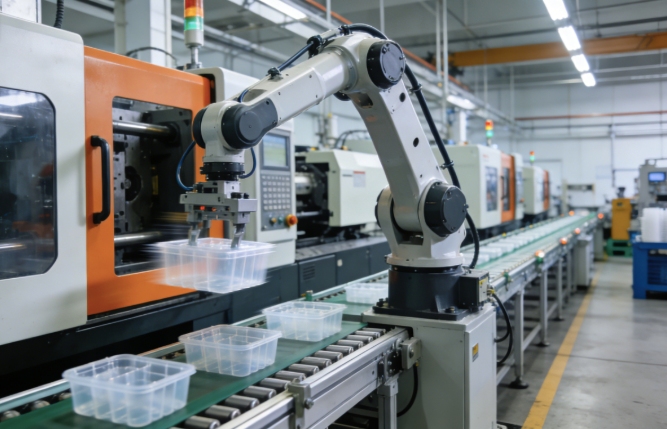
In modern manufacturing, automation plays a crucial role in improving efficiency and reducing production costs. Among the many automation solutions used in injection molding, side-entry robots are becoming increasingly popular in high-speed production environments. These robots approach the mold from the side of the injection molding machine rather than from the top, allowing faster part removal and smoother integration with automated systems. As manufacturers pursue higher productivity, stable product quality, and lower labor dependence, understanding the advantages of side entry robots compared with traditional top entry robots is becoming increasingly important.
Faster Cycle Times And Higher Production Efficiency
One of the most significant advantages of side-entry robots is their ability to support extremely fast production cycles. Because they enter the mold area from the side, their travel distance is shorter, and their movement path is more direct than that of top entry robots. This allows faster pick-and-place operations and helps reduce the total cycle time of injection molding processes.
Key efficiency benefits include:
- Rapid part removal: Side entry robots can enter the mold area immediately after the mold opens and remove finished parts within a very short time. This minimizes idle time and allows the injection molding machine to quickly proceed to the next production cycle.
- Continuous production flow: These robots can easily transfer parts directly onto conveyors, cooling systems, or packaging lines, ensuring a smooth and uninterrupted manufacturing process.
- Higher machine utilization: Faster handling operations allow the injection molding machine to operate closer to its maximum capacity, which increases overall production output.
For manufacturers producing high-volume plastic components, even a small reduction in cycle time can result in significant productivity gains.
Space-Saving Design And Flexible Integration
Another important advantage of side entry robots is their compact and practical design. Unlike top entry robots that require overhead installation and additional vertical space, side entry robots are installed beside the injection molding machine. This structural difference makes them highly suitable for factories with limited ceiling height or crowded production floors.
Important spatial advantages include:
- Lower height requirements: Since the robot does not move vertically from above the machine, factories with lower ceilings can still implement automated robotic systems without major structural modifications.
- Easier system integration: Side entry robots can be connected directly with conveyors, vision inspection systems, or packaging units, forming a highly efficient automated production line.
- Optimized factory layout: Installing robots on the side allows more flexibility in arranging equipment, improving overall production line organization and workflow efficiency.
These features make side-entry robots an excellent choice for manufacturers planning to upgrade existing injection molding facilities.
Lower Energy Consumption And Reduced Maintenance
Operational efficiency is not only about speed but also about long-term cost control. Side entry robots typically consume less energy than traditional top entry robots because their motion systems are simpler and their movement paths are shorter. This contributes to lower electricity consumption and more stable long-term operation.
Operational benefits include:
- Energy-efficient operation: Shorter travel distances and streamlined motion mechanisms reduce the energy required for each production cycle.
- Reduced mechanical stress: Fewer vertical lifting movements mean less strain on motors, rails, and transmission components, which helps extend equipment lifespan.
- Simplified maintenance procedures: Side entry robots usually have a more accessible structure, allowing technicians to inspect and maintain components more easily, reducing downtime and maintenance costs.
These advantages help manufacturers reduce overall operating expenses while maintaining reliable automation performance.
Ideal Solution For High-Speed Injection Molding
High-speed injection molding requires extremely fast and precise part handling. Side entry robots are specifically designed for these demanding production environments. Their horizontal motion allows them to quickly enter the mold area, remove finished parts, and exit without interfering with the upper structure of the injection molding machine.
Typical applications include:
- Thin-wall packaging products: These products are commonly used in food and consumer packaging and require very short cycle times. Side entry robots can remove delicate thin-wall parts quickly while preventing deformation or damage.
- Disposable containers and lids: Items such as cups, trays, and lids are produced in large quantities, making automation essential for maintaining consistent production speed and quality.
- Food packaging components: Hygiene and efficiency are critical in food packaging production lines. Side entry robots ensure quick and clean part handling while reducing human contact.
- Lightweight plastic parts produced in large volumes: Products such as household items, small consumer components, and packaging accessories benefit from the fast cycle capability of side entry robots.
Because of their speed, precision, and reliability, side entry robots are widely used in industries where even minor improvements in cycle time can significantly increase total production output.
Conclusion
In summary, side entry robots provide several important advantages compared to traditional top entry robots. Their ability to reduce cycle time, save installation space, lower energy consumption, and perform efficiently in high-speed injection molding environments makes them an ideal automation solution for modern manufacturing. As factories continue to adopt smarter and more efficient production technologies, side entry robots are becoming an increasingly valuable tool for improving productivity and maintaining competitive manufacturing operations.
0