Table of Contents
The Variegated Ficus is a highly decorative indoor plant admired for its attractive green-and-cream patterned foliage. With its elegant appearance and ability to enhance the interior environment, it is widely utilized in the interior design of residences, offices, and commercial spaces. However, many plant owners often wonder whether it can survive or even thrive in low-light indoor conditions. Given that light plays a crucial role in maintaining leaf coloration, growth rate, and overall plant health, understanding this plant’s mechanisms for responding to limited light is essential for successful indoor cultivation.
1. How Low Light Affects the Growth of the Variegated Ficus
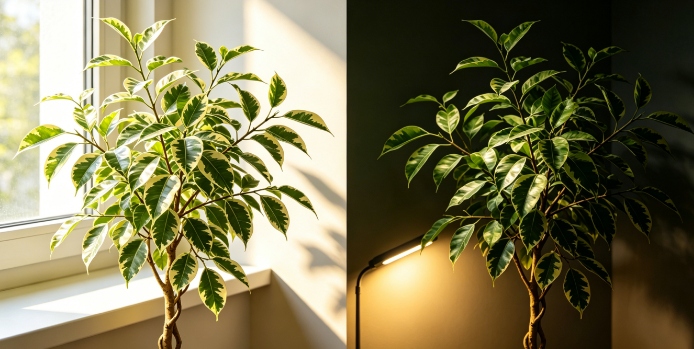
Light availability directly influences how a Variegated Ficus develops, especially in terms of leaf color and structural growth.
- Reduced photosynthesis efficiency:
In low-light environments, the plant produces less energy, slowing down growth and weakening overall vitality. - Loss of variegation patterns:
One of the most noticeable effects is the fading of creamy-white patterns, as the plant increases chlorophyll production to adapt to lower light levels. - Delayed leaf development:
New leaves may take longer to form and often appear smaller and less vibrant compared to those grown in brighter conditions.
These changes show that while survival is possible, ideal growth is limited under insufficient lighting.
2. Minimum light requirements for survival
Although the Variegated Ficus prefers bright environments, it can tolerate moderate low-light conditions if properly managed.
- Bright indirect light as the baseline:
The plant performs best near filtered sunlight, such as beside east- or north-facing windows. - Tolerance to shaded indoor areas:
It can survive in partially shaded rooms but may show slower growth and reduced coloration. - Artificial lighting support:
Grow lights can help compensate for insufficient natural light, especially in offices or interior spaces without windows. - Duration of daily light exposure:
At least 6–8 hours of indirect or artificial light is recommended to maintain stable growth.
These conditions help the plant survive, but not necessarily thrive, in low-light environments.
3. Adaptation mechanisms in low light conditions
When placed in a low-light environment, the variegated fig naturally adjusts its growth pattern to survive.
- Increased chlorophyll production:
The plant produces more green pigment to maximize light absorption, which often reduces visible variegation. - Energy conservation growth strategy:
Growth slows down to conserve energy, prioritizing survival over decorative appearance. - Directional growth toward the light source:
Stems and leaves may bend or stretch toward nearby windows or lamps, a behavior known as phototropism. - Leaf size adjustment:
Some plants develop larger green leaves to capture more light, though this may reduce aesthetic balance.
These adaptations allow survival but often change the plant’s ornamental characteristics.
4. How to improve growth in low-light indoor environments
Even in low-light settings, proper care strategies can significantly improve the performance of a Variegated Ficus.
- Use supplemental lighting:
Full-spectrum LED grow lights can simulate natural sunlight and maintain leaf coloration. - Rotate the plant regularly:
Turning the plant every one to two weeks ensures even light distribution and prevents uneven growth. - Prune leggy branches:
Trimming elongated stems encourages bushier growth and improves overall structure. - Reduce overwatering:
Low light slows water absorption, so adjusting watering frequency prevents root issues.
By applying these methods together, plant owners can somewhat reduce the negative impact of low-light conditions.
Conclusion
The Variegated Ficus can survive in low-light indoor environments, but it does not truly thrive under such conditions. While it may continue to grow, its variegation may fade, and its structure may become weaker and less attractive. To maintain its vibrant appearance, bright indirect light or supplemental lighting is strongly recommended. With proper adjustments in lighting, watering, and maintenance, the plant can still remain healthy and decorative even in less-than-ideal indoor environments.
0