Table of Contents
The ligustrum tree is widely used in landscaping because of its fast growth, dense foliage, and ability to form attractive hedges and privacy screens. However, its impact on the environment is a highly controversial topic among horticulturists, ecologists, and landscape designers. In some regions, it is valued as a useful ornamental plant that enhances green spaces, while in others it is considered potentially invasive due to its strong spreading ability. Understanding whether the ligustrum tree is invasive or environmentally friendly requires looking at its growth behavior, ecological influence, and how it interacts with local ecosystems under different conditions.
Growth Behavior and Invasive Potential of the Ligustrum Tree
The main reason the ligustrum tree is sometimes labeled as invasive is its vigorous growth and ability to spread quickly when conditions are favorable.
- Rapid reproduction and expansion
The ligustrum tree produces abundant seeds that can be dispersed by birds and wildlife. In suitable environments, these seeds germinate easily, allowing the plant to establish in areas beyond intended landscaping zones. This natural spread is one of the key concerns in ecological management. - Strong survival ability in diverse conditions
It can thrive in a wide range of soil types and climates, from urban environments to semi-natural habitats. This adaptability enables it to compete effectively with native vegetation, sometimes even growing faster than slow-growing native species. - Dense growth that outcompetes other plants
Once established, its thick canopy can block sunlight from reaching nearby plants. This shading effect may decrease plant diversity in areas where native species rely heavily on sunlight to thrive. - Regrowth after cutting or disturbance
Even when removed or heavily pruned, the plant can regenerate from remaining roots or stems. This resilience makes long-term control more difficult in unmanaged environments.
Environmental Benefits of Ligustrum Tree in Landscaping
Despite concerns about invasiveness in certain regions, the ligustrum tree also provides several environmental benefits when properly managed in controlled landscapes.
- Air quality improvement in urban areas
Its dense leaves help capture dust and airborne particles, contributing to cleaner air in cities and roadside environments. This makes it a useful plant for pollution-prone areas. - Habitat support for small wildlife
The thick foliage provides shelter for birds and insects, offering a basic habitat structure in urban green spaces where natural vegetation is limited. - Soil stabilization and erosion control
The root system helps hold soil in place, especially on slopes or garden borders, reducing erosion caused by rainwater runoff. - Green coverage in developed landscapes
In heavily built environments, it contributes to increasing green space coverage, improving aesthetic value, and reducing heat absorption from hard surfaces.
Situations Where the Ligustrum Tree May Become Invasive
Whether the ligustrum tree becomes invasive depends largely on environmental conditions and management practices. In some regions, it can spread beyond intended planting areas.
- Abandoned or unmanaged landscapes
If left unchecked, it could spread to nearby fields, forests, or nature reserves—particularly when birds widely disperse its seeds. - Warm and humid climates with long growing seasons
In these environments, the plant grows continuously for extended periods, increasing its chance of dominating local vegetation. - Lack of pruning or control measures
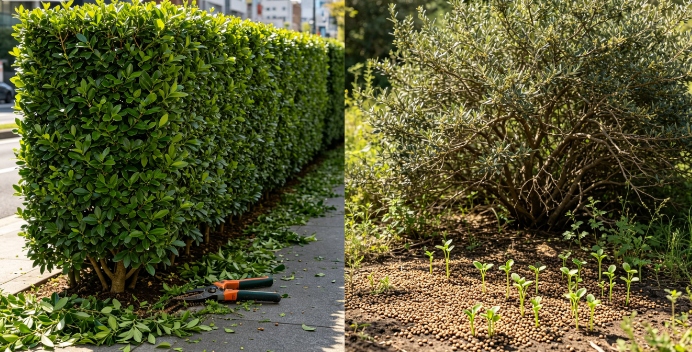
If not pruned periodically, it will form dense clumps that expand outward and suppress surrounding plants. - Competition with native ecosystems
In some ecosystems, it may reduce biodiversity by displacing native shrubs and ground plants that cannot compete with its growth speed.
Responsible Management for Environmental Balance
The environmental impact of the ligustrum tree can be significantly reduced through proper management and controlled planting practices.
- Regular pruning and growth control
Trimming prevents excessive spread and keeps the plant within intended landscape boundaries, reducing the risk of escape into natural areas. - Careful placement in designed landscapes
Planting it in urban gardens, hedges, or controlled environments minimizes interaction with wild ecosystems. - Monitoring seed production and spread
Removing unwanted seedlings early helps prevent uncontrolled propagation in surrounding areas. - Choosing appropriate varieties
Some cultivated types are less aggressive than wild forms, making them more suitable for ornamental use.
Balancing the Benefits and Risks of the Ligustrum Tree
The ligustrum tree presents both environmental advantages and potential ecological risks, depending on how and where it is used. In urban landscaping, it provides valuable benefits such as privacy, air improvement, and aesthetic greenery. However, in natural or unmanaged ecosystems, its strong growth ability can lead to invasive behavior and reduced biodiversity. This dual nature means that responsible planting and maintenance are essential for achieving environmental balance.
Conclusion
Privet trees cannot be simply classified as entirely invasive, nor can they be regarded as completely harmless to the environment. Its impact depends on location, climate, and human management. When properly controlled, it is a highly useful landscaping plant that improves urban environments and provides functional green space. However, without maintenance or in sensitive ecosystems, it may spread aggressively and compete with native plants. Therefore, the key to using ligustrum responsibly lies in careful planting, regular pruning, and awareness of local ecological conditions, ensuring that its benefits outweigh potential environmental risks.
0